
One of my earliest gaming memories centers around Steve Jackson Games’ Car Wars. As a young middle school gamer in the early ‘90s, I had played Advanced Dungeons & Dragons, and of course I was familiar with classic board games like Monopoly and checkers. But I could tell right away that Car Wars represented something different.
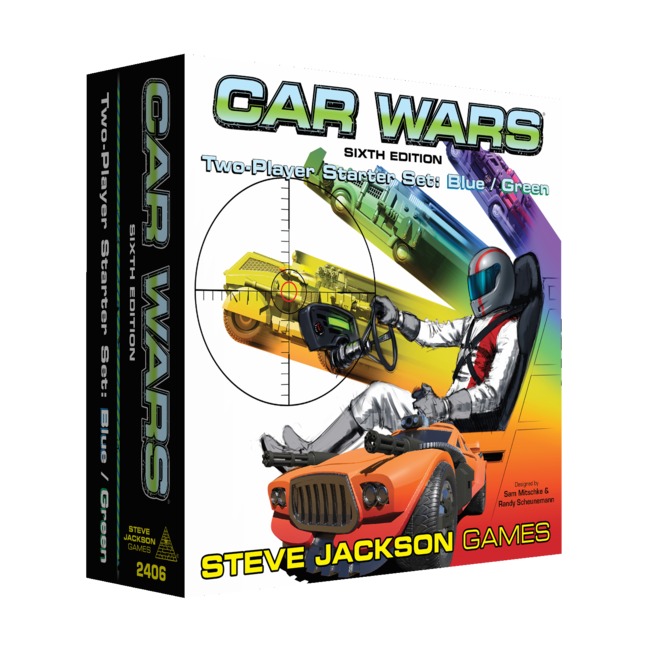 For those unfamiliar, Car Wars is a vehicle-based dueling game set in a dystopian, near-future America. Souped-up cars with machine guns and armored plates try to blast other, similarly armed cars to smithereens in a never-ending car chase that takes place on the dining room table. It’s basically Mad Max with six-sided dice and tiny, die-cut cardboard cars.
But more than its theme, Car Wars introduced me to a whole new kind of game, similar to but also different from the games I already loved. It was like a roleplaying game, with its careful building of your individual car and selecting just which weapons you’d take and where you’d put them. It also had the feel of a board game, but with more freedom and a set of rules that created something akin to realism inside the limits of its over-the-top premise.
Most of all, as my middle school friend and I stayed up into the late hours of a summer night, munching on Doritos and blasting one another’s meticulously designed vehicles into burning slag, Car Wars was fun.
I wondered who came up with this game, and what else they had made. That question turned out to have a lot of answers, and decades later, the company is still adding to them.
We spoke with Steve Jackson, founder and President of Steve Jackson Games, about the games that built the company and what he’s working on next.
Origin Story
Steve Jackson has been designing games professionally since the 1970s. His first published design was Ogre, released in 1977 by a company called Metagaming Concepts, run by Howard Thompson. Through Metagaming, Steve also released the Melee and Wizard microgames. By 1980, Steve and Howard weren’t seeing eye to eye, and Steve left to found his own company.
“That old bugbear ‘creative differences,’” Steve says. “Howard quite reasonably wanted to run his company his way. I didn’t like his way. I was also unaware of the statistics regarding failures of new businesses capitalized under $10,000…”
A handful of releases by the new company followed, with Car Wars debuting in 1981. And Car Wars is not the only early Steve Jackson game to still be going strong decades later.
Half a Century of Ogre
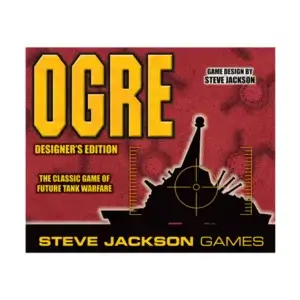 A hex-and-counter game of futuristic warfare, Ogre pits a lone, giant cybernetic tank against a defending force of infantry, artillery, and armor. In 2012, a crowdfunding campaign to publish the Designer’s Edition of Ogre raised over $900,000. It has appeared as a board game, a miniatures game, and even a video game. As Ogre approaches its 50th anniversary, Steve has more in store.
“I grin every time I think about it…and about the 2027 releases we are going to do for the game’s 50th anniversary,” Steve says. “I won’t deny for a second that it’s nice to realize that I began my career with something that will pretty clearly outlast ME.”
A Game for Any Setting
Among tabletop roleplaying fans, Steve Jackson Games is perhaps best known for their Generic Universal RolePlaying System, GURPS. First released in the late 1980s, GURPS is designed to run any setting or genre, using the same core mechanics, from dungeon-crawl style fantasy to science fiction, and from historical realism to adaptations of specific movies and novels. There are even GURPS versions of other tabletop roleplaying games, like Vampire: The Masquerade and Bunnies & Burrows.
The current version of GURPS, 4th edition, came out in 2004. In 2026, Steve Jackson Games published a revised version, a giant 592-page hardcover book that combines the core rules of 4th edition into a single volume. When asked about what has made GURPS such a longstanding mainstay as a generic system, Steve doesn’t know the magic recipe, but he has a pretty good theory.
“Oooh, complicated question. And when I figure out the real answer, I’ll share,” he says. “What worked for GURPS was a point-buy system with a huge number of different things that could be bought, and very few cases of ‘if you do X, then Y is ruled out.’”
In other words, no character classes, and few rules that lock out other options.
“Now, that is not the only reason by far that I think the system has succeeded,” Steve continues, “but it’s the big reason that it can stretch to almost any genre and, even better, to almost any mashup.”
GURPS features a very large library of supplemental books to help a GM along the way. Popular favorites include GURPS Powers and GURPS Horror. Many of the more setting and genre-focused books, like GURPS Vikings, have a reputation for being so well written and researched that they are useful as reference materials, even for people who don’t run GURPS.
“It was not always a deliberate goal,” Steve says, “but when we realized that it was happening, we were happy, and we have worked ever since to deserve and enhance that rep.”
I’m one of those readers. My well-worn copy of GURPS Vikings has been a go-to resource across a half-dozen non-GURPS campaigns, and at least one draugr-haunted campaign that did use the GURPS rules.
Stab Your Buddy, Take the Loot
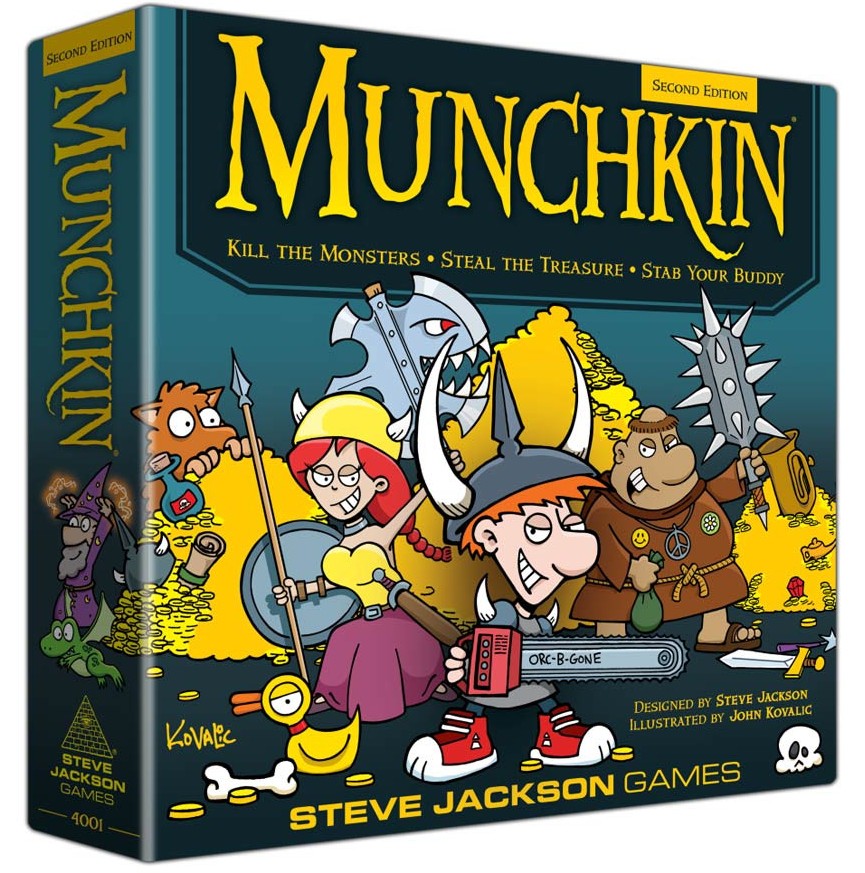 If Ogre and Car Wars represent Steve Jackson Games’ origin story, then Munchkin is the breakout character that kicked open the door in the second act and promptly stole the show.
Munchkin is a card game that plays up the silliest, most over-the-top tropes of tabletop RPGs. Players bash their way through a deck of cards, fighting monsters, looting treasures, and betraying each other, all in the quest for the elusive 10th level. The game’s signature art comes from John Kovalic (Dork Tower, Chez Geek), and it’s rife with puns and gaming in-jokes.
Asked what Munchkin understands about players that other games don’t, Steve boils it down to a single insight.
“Even the most dedicated roleplayers don’t want to roleplay all the time,” he says. “Sometimes they like Munchkining! And they appreciate a game that gives them permission to be their bad selves, and goes back in the box when it’s over.”
Munchkin has been a mainstay of the company’s catalog for a quarter century. In 2026, Steve Jackson Games released Munchkin Second Edition. It promises faster play and setup, and players can now steal gold coins from monsters to spend on levels.
In addition to the base game, Steve Jackson Games has also published a wide range of expansions and variant versions over the years, including Munchkin Zombies, Munchkin Cthulhu, and Munchkin Apocalypse.
There is also a Munchkin Shakespeare. Even the Bard himself enjoys a good backstabbing now and then.
Hail! Discordia!
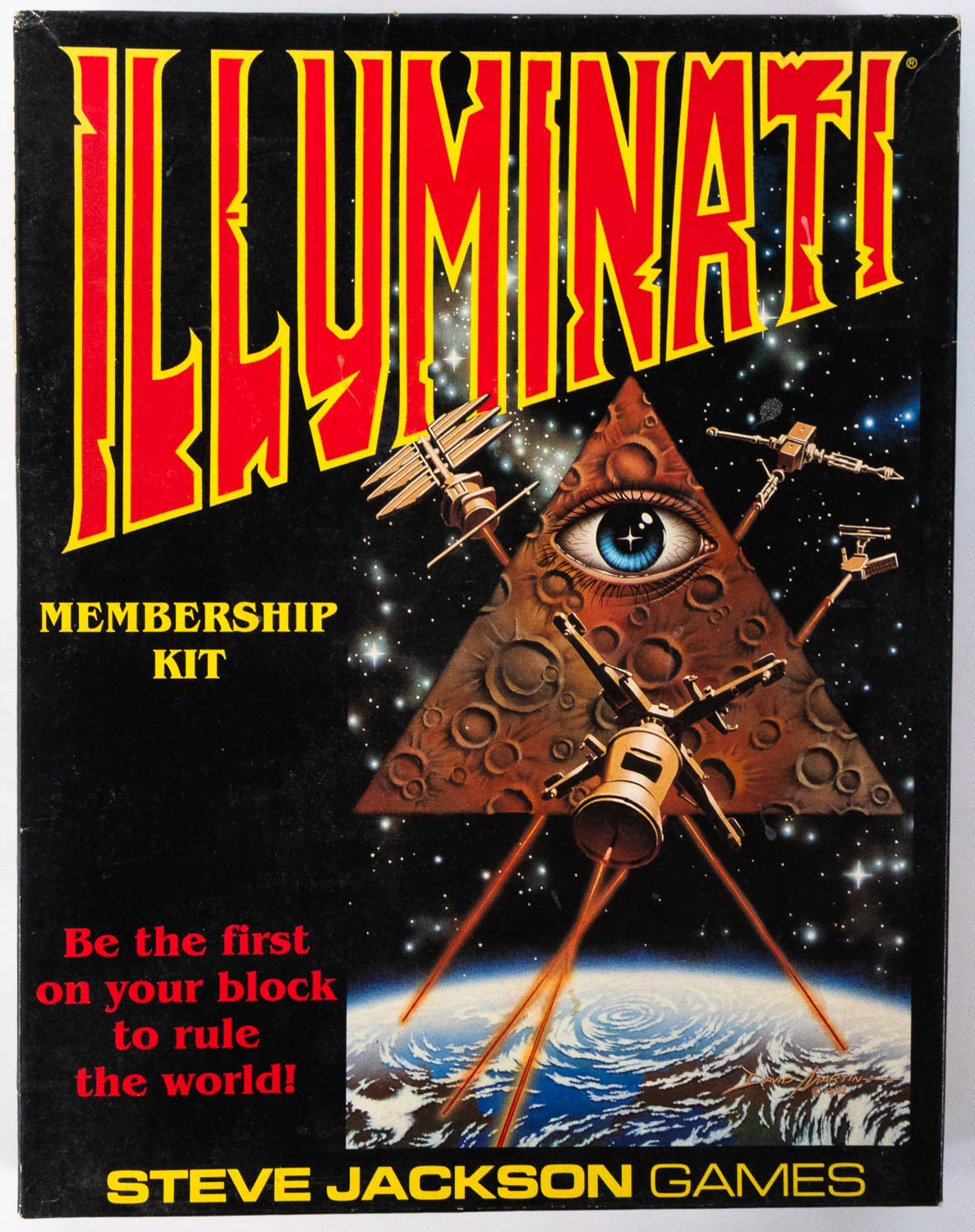 If you look deep enough into the Steve Jackson Games catalog, you may soon begin to see the shadow of something…conspiratorial. The company logo features a pyramid and all-seeing eye. The mysterious word fnord keeps cropping up in their games and on their website. And they sure do make a lot of games related to the Illuminati.
I asked Steve directly about the meaning behind all these mysterious references. His answer was less than forthcoming.
“Aw, come on. You think a simple question is going to get you what the Secret Servitors could not get with their Mind Beams and Vanishing Subpoenas?”
In all seriousness (probably), Steve Jackson Games’ connection with the murky world of conspiracies mostly stems from one game in their catalog, Illuminati: The Game of Conspiracy. In this card game, players take on the role of secret groups trying to manipulate their way to total world domination. It’s all very tongue-in-cheek and satirical (or is it?).
That Time Steve Jackson Games Got Raided by the Secret Service
No profile of Steve Jackson Games would be complete without a mention of the time the U.S. Secret Service raided their offices in Austin, Texas. Specifically, on March 1, 1990, agents searched the offices and seized several computers, including one running the company’s online bulletin board, called the Illuminati BBS, along with files for a book in progress, GURPS Cyberpunk.
Steve Jackson Games sued with backing from the Electronic Frontier Foundation, a nonprofit formed later in 1990 to defend civil liberties in the digital world, in part because of cases like this one. In 1993, a federal court ruled largely in the company’s favor and awarded damages.
It’s all very ironic: a company known for games about fictional conspiracies found itself caught up in a very real investigation. More than three decades later, Steve says that the world has changed in how it views gaming, technology, and hackers.
“Oh, absolutely. Gaming is a huge part of the entertainment industry, earning billions of dollars a year (but does even one crummy billion come in these doors? It does not. Life is hard.) Technology is now understood generally and clearly to be the only thing that has a chance of saving us from itself. And black-hat hackers are no longer curious college kids. Now they’re big business, stealing and extorting.”
Steve says it doesn’t surprise him that a consequential digital rights organization can trace its roots back to a tabletop game company.
“I spent five semesters in law school,” he explains. “Many of our most important legal cases, the ones that set significant precedents for good or evil, originated from humble, mundane, or downright weird disputes.”
A Return to Design
In September 2026, Steve Jackson Games announced that Steve was stepping down as CEO, with longtime team member Sabrina Gonzalez taking over the role. Steve remains the company’s founder and President.
“It means that I can concentrate on game design and development, which makes me very happy,” he says.
One project he’s eager to return to is Nameless Island.
“I can finally finish development on Nameless Island, a roleplaying / survival game / boardgame that has been on the shelf here for way too long!” he adds.
Years ago, after getting trounced in a few games of Car Wars, I wondered what else Steve Jackson Games had made. More than three decades later, I’m still finding out.
Thanks to Steve Jackson for taking the time to speak with us. You can read the rest of his interview below.
A Few Questions with Steve Jackson of Steve Jackson Games
The 3d6 bell curve shows up in GURPS as well as Melee / The Fantasy Trip. What drew you to that curve over a flat polyhedron roll? Do you still prefer it to the d20?
For some things, yes. For other things, no! Part of the art of game design is deciding when to use a randomizer at all, and if so, what kind. If you do a game convention, suggest that question as a panel…
Do you still find time to just play games? If so, what’s been on your table lately?
Not as much as I’d like. But yes. Terraforming Mars springs to mind as one that has been on the table several times. A go-to game for small groups has recently been Paperback (Tim Fowers, Jeff Beck, and Skye Larsen) and its semi-sequel Typewriter. Clever, usually fast-moving, with beautiful components. As though Scrabble and a deck-builder had two little babies and raised them on a diet of love and red meat. But if a dozen people come over for Game Night, we break out our TWO sets of So Clover.
After everything you’ve designed and built, is there a game idea, genre, or mechanic you still haven’t gotten to tackle the way you want to?
Oh yes. I doubt I will ever reach the bottom of the list.
Do you have a favorite shape, and why is it the hexagon?
Actually, I’m rather fond of the Einstein, but I have not figured out how to work it into a game.
What’s the weirdest Steve Jackson Games idea that almost happened but never made it to print?
Actually, I can’t tell you. I was contracted to create an ARG. Under NDA, of course. It was to be a promotional project. The sponsor changed ad agencies, and the new agency threw out all the old agency’s ideas. I was generously paid to bury everything I had done, and that was that!
Munchkin has crossed over into things like Adventure Time, Rick and Morty, and even the Nightmare Before Christmas. If you got to do one more wildly unlikely Munchkin crossover, what would it be?
I guess I could tell you, but I won’t, because it’s in negotiation!
If you had to pick one: dice, cards, or tiles?
Dice are useful. Cards are useful. Tiles are heavy, expensive cards.


