
Para Bellum Wargames
What comes first, the game or the world it’s played in?
If you ask Para Bellum Wargames about the games and miniatures they publish, the first thing they’ll tell you about is the World of Eä, the fantasy setting in which all these tabletop battles take place.
According to Para Bellum’s founder, Stavros Halkias, the seeds of what would eventually become Conquest: The Last Argument of Kings were planted at his brother’s urging. “He saw me bored with my daily life and urged me to experiment,” Stavros explains. “I took his advice, saw a gap in the wargaming market which I loved and leapt in! So, at heart, it is a family business.”
We spoke with Stavros, along with Global Head of Sales and Marketing Daryl McKay and Senior Product Manager Leandros Mavrofekalos, about the world they’ve built and the two games that bring it to life: Conquest: The Last Argument of Kings and Conquest: First Blood.
Realistic Fantasy
Stavros describes the World of Eä as realistic fantasy. This means a setting with familiar fantasy elements that’s grounded in real-world history and mythology,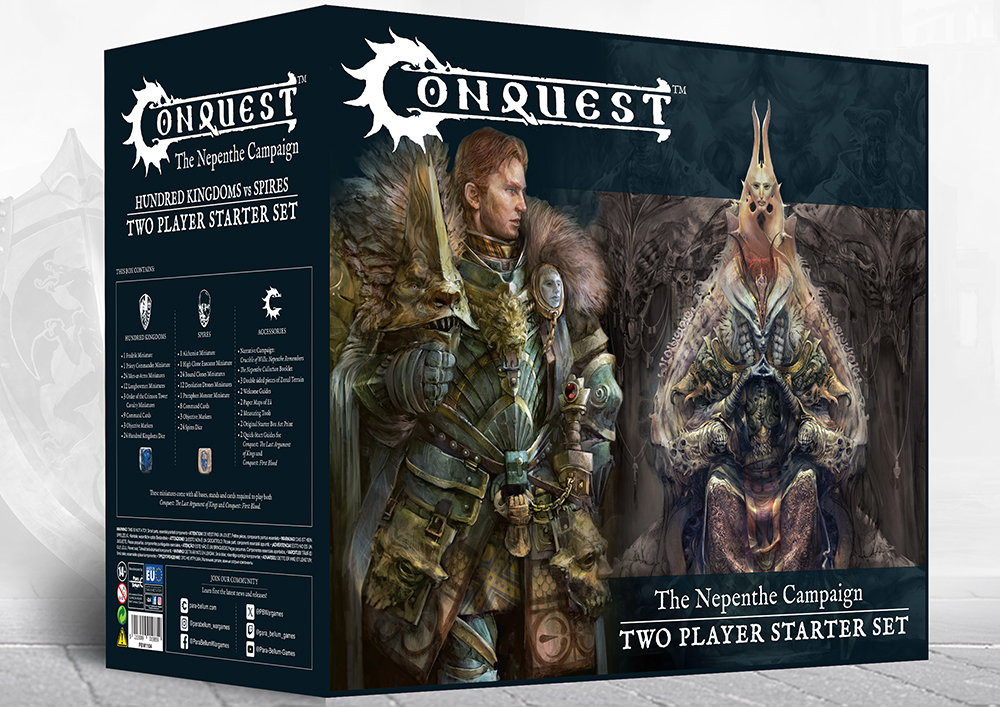 with influences ranging from the ancient Greeks, to the Celts, to Tolkien and classic fantasy.
“The goal is to have a setting where almost everything is identifiable at a glance and born of the western mythologies, but with a significant twist,” Stavros explains.
Some examples of those twists are the Old Dominion, which are essentially undead Roman legions, or the post-Ragnarok Vikings who survived the death of their own gods. And then there are the dinosaur-riding orcs.
Each faction features its own unique history, culture, and motivation. Para Bellum’s philosophy is that by tying these armies to a detailed world, players find it far easier to make an emotional connection to the outcome of each game.
According to Senior Product Manager Leandros Mavrofekalos, the setting even plays into the design of the game rules themselves.
“A rich, believable world provides ‘realistic’ reasons why factions are evenly matched, or why one has triumphed over another,” he says. “When these realistic power dynamics are accurately reflected in the game’s rules, they naturally carry through into play.”
Of course, the lore is also there to help answer another practical question: why are all these armies battling each other in the first place? By offering a setting filled with powerful characters with detailed histories, Para Bellum hopes to answer that question in a way that drives play and generates new stories and further conflicts in the process.
Stavros puts it even more simply. “The background, the lore, the ‘fluff’ are absolutely critical to the enjoyment of a game,” he says. “Without strong world building we might as well be playing chess with dice.”
Developed in the EU
Para Bellum is based in Greece and all of their products are manufactured within the European Union. According to Head of Sales and Marketing Daryl McKay, everything from the resin figure sculpts to the rulebooks, the dice, and the boxes that hold them are made in the EU. Daryl says the company is particularly proud of both the quality of their products as well as the value they offer their customers.
“Where many publishers’ infantry sets have 6-8 models now, ours remain a 12 count infantry stand for typically a lower price. Our local and hand-crafted resin is a superior quality which allows for a better sculpting experience, while also being more durable for game play and transport.”
All Para Bellum miniatures and molds are handcrafted, and a great deal of creative energy goes into each one.
“Miniature design is the beating heart of the game and company,” Stavros says. “It all starts with a story, my favorite part of the whole process. Each troop is linked to its faction, and through it to the growing social, military and economic tapestry that makes our world come alive.”
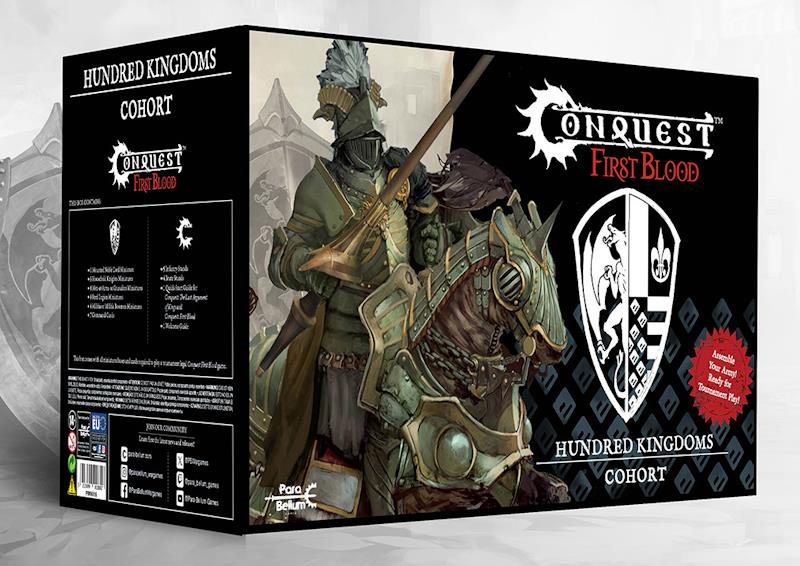 Once they have the lore down, the idea passes to the concept artists, who sketch out illustrations of how the finished product might look. These interpretations often affect the original concept of the troop itself, resulting in small design or lore changes that, in turn, influence further sketch drafts. Once they settle on a final look, the creative team produces variations for the model – different poses or small detail changes to help distinguish individual troops or monsters on the tabletop. With those in place, the next step is to produce model sheets, the visual guides that help in the sculpting of the actual models. The final process is the sculpting itself, which Stavros admits is the point where his own involvement becomes more limited.
“Oddly enough, the sculpting process is the most transformative, but also in many ways the least interactive for me,” Stavros says, “as the concept has already been pinned down.”
One Army, Two Games
Both Conquest games, The Last Argument of Kings (TLAOK) and First Blood, are designed to be played with the same models. The physical design of the components reflects that dual purpose from the ground up.
“Each square movement tray has a round base component,” Daryl explains, “so that fans can use their miniatures to play a fast-paced style of Rank and Flank using The Last Argument of Kings style of play, or quick 3D Skirmish play with First Blood.”
While the models are interchangeable, the philosophy behind the two games differs in scale and approach. TLAOK is a large-scale game that focuses on mass battles with up to 80 or more models per side.
First Blood, on the other hand, offers a shorter, skirmish-based game that requires fewer models to play. Para Bellum recently released a new edition of First Blood, and Daryl is confident it will broaden the game’s appeal.
“We are confident that this update is going to really wow current players while bringing in many fans to miniature wargaming for the first time,” he says.
Future Conquests
Para Bellum’s ambitions for the World of Eä are far from exhausted. Stavros says the setting was designed with 24 factions in mind, with new releases planned at a steady pace for years to come. Alongside that, the company is committed to supporting the players who are already invested in the world through community programs, rules updates, and ongoing engagement long after purchase.
For a company that started with a brother’s urging and a leap of faith, Para Bellum has traveled a considerable distance. For them, the answer to the question is that neither the game nor the world comes first, but rather that one can’t exist without the other.
You can read the rest of our conversation with Stavros, Daryl and Leandros from Para Bellum Wargames below.
A Few Questions with Para Bellum Wargames
When it comes to mechanics and gameplay, what do you feel sets Conquest apart from other fantasy wargames on the market?
Daryl: In addition to the two styles of play available with the same minis, an incredible feature of Conquest is the focus on lore. Narrative story telling play is built into our game, and incredible campaigns can be played over months to really tell stories as you play. The miniatures themselves are all crafted with great style, becoming true works of art at the hands of the many painters and players who express themselves through these sculpts.
How do you support and grow your global player community?
Daryl: We are really blessed to have a passionate player base, many who have been supporting us from the beginning and who have armies for many if not all of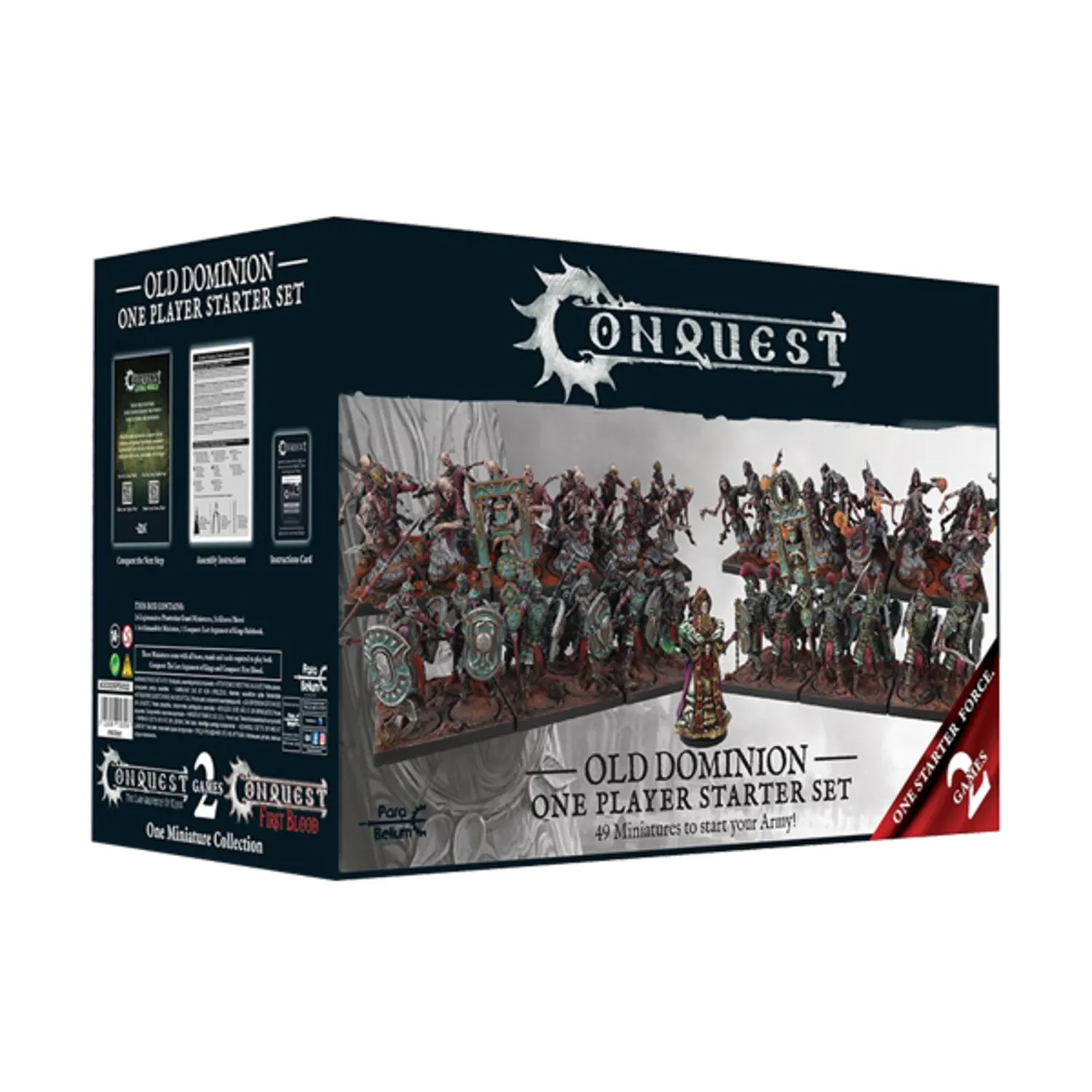 the unique factions. Players can apply to become a Vanguard to become a leader of the Conquest Community in their store or club. Our Happy Hours have been a wonderful way for us to communicate in voice and video with Gamers.
Conquest features a wide variety of factions, each with distinct aesthetics, lore, and playstyles. Could you introduce a few standout factions and what makes them compelling?
Daryl: How can we pick just a few…? They are all interesting and unique, which is another standout feature of Conquest. You can choose the style and aesthetic that speaks to you and your play style. Each faction has their unique play style and rules adaptations as well. If you really love armored men and cavalry, Hundred Kingdoms will speak to you. If you lean towards a Weeb or a fan of the Samurai aesthetic, Yoroni is your jam. Love Dinos? (who doesn’t?), the W’adrhûn will be your faction. Zombies more your groove, how the Roman Undead army that is the Old Dominion…. and many more!
With so many factions and unit options, how do you approach balance? How do you ensure each army maintains its unique flavor without overwhelming the game’s overall structure?
Leandros: As we mentioned earlier, the reason we’re able to expand the game in a meaningful way is that everything we add is first “baked” organically into the world itself. If it makes sense for a regiment or faction to exist within the Conquest setting, then it naturally makes sense for it to appear in the game of Conquest as well. Of course, this is where game design must step in, to determine which elements of a faction’s story fit cleanly within the current design space, where that space can be expanded to support new ideas, and where certain thematic interpretations may ultimately prove uninteresting or impractical to translate into rules.
What’s the best entry point for a new player curious about Conquest? What would you recommend as their first step into the game?
Daryl: If Rank and Flank is your primary focus to play, then a great place to start is our 1 and 2 Player Starters, which are available in a form for all of the 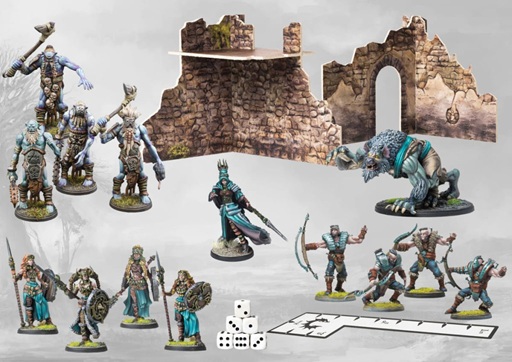 factions. If you want to play with a smaller footprint and army in Skirmish style of play (knowing you can always add to make a Rank and Flank army) than a First Blood Warband … really covers all you need to start! These come with dice, terrain and more to really start you off well.
Do you have a personal favorite sculpt or model in the Conquest range?
Daryl: Personally, I have always loved the Flamecaster. As the commercial person in the company, he has a flair I can relate to! More recently the Yoroni Domaru-Domashi have challenged the laws of physics to create an incredible in-game look.
What’s the most impressive Conquest battle or army display you’ve ever seen at an event or online? Anything that really stuck with you?
Leandros: Despite having seen countless beautifully painted armies and witnessing many incredibly close matches over the years, what has always stayed with me are the very first demo games we ran at Essen Spiel back in 2016–2017. At the time, we only had resin prototypes of our first Core Set, but playing the game there and seeing people’s reactions made it clear to me that we had something truly special in our hands.
Which faction do you play the most, and why?
Stavros: Hundred Kingdoms. As I said before, they are the [human] point of view. Huge monsters are cool, but they are cooler when compared against a bunch of dudes with swords. And those dudes with swords? How cool are they to take on a frickin’ monster?!
Leandros: Until recently, Yoroni was my bread and butter – as people have probably noticed from the painted photos I’ve been spamming on Discord haha! – with Sorcerer Kings and W’adrhun before that. With First Blood on the way, however, I finally had the chance to focus on smaller projects I’ve always wanted to tackle, without having to commit to an entire army all at once. A 100K Noble Lord with individually converted Steel Legion and Mounted Predator chasing down enemies alongside swarms of Hunting Packs, have now made their way back onto my WIP table.
Do you like to paint to a tabletop standard or chase the perfect display piece?
Leandros: I tend to find myself somewhere in the middle. I enjoy challenging myself and pushing a paint job, but turning that level of effort into a full army requires a lot of extra drive. For TLAOK, I lean more toward a “high tabletop” standard. First Blood, on the other hand, is my go-to when I want to really push my painting without worrying about replicating the same approach dozens of times. It’s become my outlet for more artistically challenging projects.
What’s your favorite unit type to field: infantry, cavalry, or monsters?
Stavros: Infantry. All the way. Love the feeling of massed ranks and nothing gives me that feeling like big blocks of infantry.
Leandros: This is another area where new First Blood has really changed things for me. I used to build my armies largely around Size 2 units and larger – fewer models to paint with strong visual impact on the tabletop. Lately, though, I’ve been having a lot of fun rediscovering the beauty and nuance of playing the “little guy” in a three-dimensional, highly interactive terrain environment. I can confidently say that I’m really enjoying all of it!
Thanks so much to all three of you for your time!


